
When Does Commitment Become a Safeguarding Risk?
Heatwaves, youth football and whether we are asking the wrong people to make the decision.
6/24/20262 min read
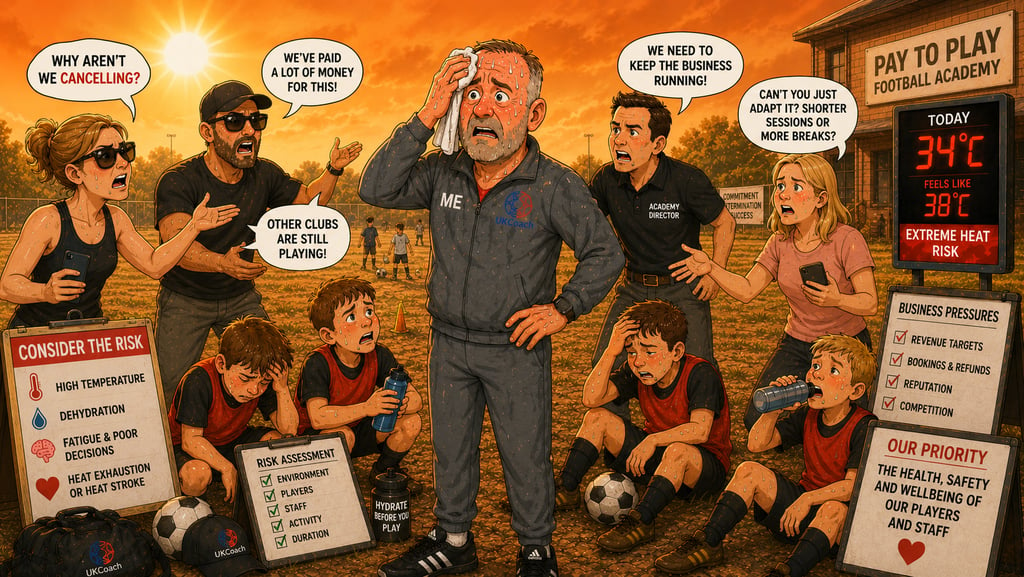
When Does Commitment Become a Safeguarding Risk?
Heatwaves, youth football and whether we are asking the wrong people to make the decision.
As temperatures continue to rise across the UK, the current climate feels like a good moment to reflect on player welfare and safeguarding in football.
As coaches, teachers and activity providers, we spend a lot of time talking about safeguarding in terms of behaviour, environment and wellbeing, but weather and heat exposure are also safeguarding issues.
Current guidance from the FA, UK Health Security Agency (UKHSA) and the Child Protection in Sport Unit (CPSU) emphasises that organisations have a responsibility to actively assess environmental risk and adapt activities when conditions become unsafe.
High temperatures increase the risk of:
• Dehydration
• Heat exhaustion and heat stroke
• Reduced concentration and decision-making
• Increased injury risk due to fatigue
• Distress and reduced enjoyment, particularly in younger players
This phenomenon applies not only to players, but also to coaches, volunteers and staff who may be delivering multiple sessions per day.
There are practical steps that can reduce risk:
☀️ Move sessions to cooler parts of the day
💧 Increase water breaks (before players ask)
🏃 Reduce intensity and duration
🌳 Use shade wherever possible
🧢 Encourage hats and lighter clothing where appropriate
⚽ Adapt activities and expectations
❌ Be prepared to cancel if conditions become unsafe
The FA’s warm weather guidance advises adapting activity and notes that vigorous physical activity may not be appropriate during periods of extreme heat (around 30°C+). CPSU guidance also highlights that weather conditions should form part of safeguarding and risk assessment procedures and that activities should be stopped, postponed or moved where necessary.
But I do think there is also a wider conversation worth having.
Should pay-to-play organisations continue to operate as normal during extreme weather, particularly when decisions about attendance, session intensity and safety are effectively being pushed onto parents, coaches and participants?
Commercial pressures are real. Families expect sessions to run. Coaches want to support players. Organisations don’t want cancellations.
However, safeguarding shouldn’t become a customer choice.
The safest decision is not always the most convenient or the most profitable one.
Sometimes good coaching isn’t finding a way to deliver the session – it's recognising when player and staff welfare should come first.
Interested to hear thoughts from other coaches, parents and organisations on where that balance should sit.
Be safe out there!