
I thought I Needed a Degree...
3 years of journey, almost at an end?
7/3/20267 min read
I Thought I Needed a Degree
Most of the moments that end up changing your life don't announce themselves. There's no music swelling in the background, no flash of insight, nothing that feels significant until years later, when you look back and realise that one small decision quietly rerouted everything that came after it.
For me, that moment was clicking ‘submit’ on a university application. It sounds almost anticlimactic, doesn't it? There was no dramatic turning point behind it, no life-changing conversation, no inspirational speech, no sudden urge to reinvent myself. My reasons for applying were far more practical than that. I simply wanted to keep building a career in football.
By the time I applied, I was 52 years old. I'd already spent years coaching in the UK, Canada and China, working with players, parents, schools, community organisations and provincial associations. Football had long since stopped being a hobby; it had become my profession and, in many ways, part of my identity. Yet despite all of that experience, I kept reaching the same uncomfortable conclusion: experience wasn't opening doors the way it once had. My Canadian coaching licence didn't carry the same weight outside Canada, so working towards a UEFA licence became a priority; it's far more globally recognised and gave me a real shot at finding work back in the UK. The degree was about something slightly different: an industry and academic qualification that stood on its own merit, and one that would keep the door open to a work visa if I ever wanted to explore working abroad again. On paper, I often found myself falling short before anyone had even met me. I remember looking at job descriptions and thinking, I can do this job, I've done this job. So, I made a decision. If the industry had changed, I needed to change with it.
Looking back now, I smile at how simple I believed the journey would be. Study hard, get the degree, add it to the CV, carry on coaching. I genuinely thought I was signing up for three years of academic work that would simply validate everything I'd already learned through experience. I couldn't have been more wrong. The qualification was only ever the visible outcome. The real education happened somewhere else entirely.
Most people my age aren't deciding to become students again, and I certainly questioned whether I was doing the right thing. It had been decades since I'd written anything remotely academic; critical analysis, literature reviews and referencing all belonged to a world I'd never really been part of. I was far more comfortable standing on a football pitch than sitting in a classroom, and I wasn't at all convinced I could complete a degree. Confidence is a strange thing that way. I could stand in front of players or coaches without a second thought, yet the idea of writing a 3,000-word academic paper filled me with dread. Looking back, I also realise how much pressure I placed on myself. My age and experience cut both ways; they gave me a depth of knowledge many younger candidates simply didn't have, but I was also noticing, more and more, that I didn't fit the demographic or the image a lot of clubs and academies seemed to be looking for when they pictured who they wanted in these roles. At that stage of my career, I didn't feel I had the luxury of spending another one or two years on a Master's before looking for roles. I wanted this degree to count, not because employers would necessarily care whether I graduated with a First or a 2:1, but because I would.
Finding My Feet
One of the biggest surprises was discovering that learning itself is a skill. In the early days of the course, I spent almost as much time learning how to study again as I did learning the course content. University wasn't interested in what I thought; it wanted to know why I thought it, where the evidence came from, and whether I could justify my conclusions. At first, I found that frustrating. Gradually, I found it fascinating. The more I researched, the more curious I became; one journal article led to another, one assignment opened the door to another question. Looking back, the curiosity had always been there. The degree simply gave it direction.
The first assignment came back with a good mark, and I told myself I'd been lucky. The second came back the same way, and I told myself the same thing again. That pattern held for most of the first two years of the course. Then came the first assignment of my final year, and I received the highest mark I'd achieved on any piece of written work during the entire degree. Oddly enough, it wasn't really the mark that mattered. For nearly three years I'd consistently produced good work, and I'd always found a reason to dismiss it: the marker had been generous, the topic had suited me, the next assignment would surely expose me. The difference this time wasn't the grade. It was me. For the first time, I let myself believe that a First-Class degree was genuinely possible. The evidence had been there all along; my confidence had simply taken three years to catch up.
When the Classroom Became the World
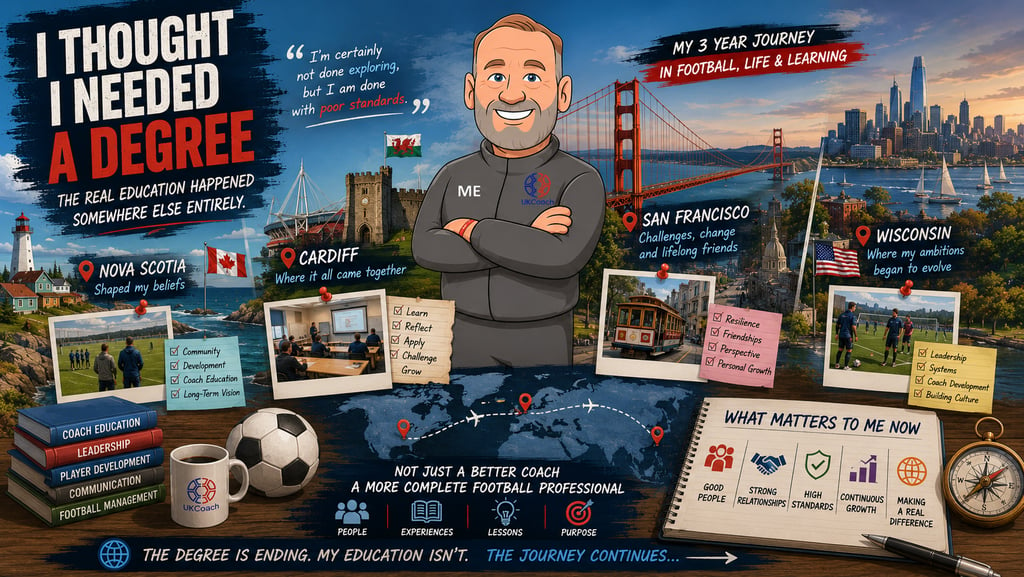
One of the reasons I chose the University of South Wales was its structure. Independent study, remote tutor support and residential weeks in Cardiff let me keep working while I studied, which suited me perfectly, because theory and practice never stopped informing one another. An assignment would send me back to something I'd experienced years earlier; equally, something that happened during the working week would send me back to the research looking for answers.
Long before the degree, I'd worked in Canada and China, and during the course I found myself revisiting those experiences through a completely different lens. Canada reinforced a lot of what I already believed about community football, long-term player development and supporting coaches rather than simply delivering programmes at them. China taught me something sharper: that success isn't about expecting people to adapt to you, but about adapting to different cultures, understanding different perspectives and building relationships through respect.
Somewhere in the middle of all this, closer to home, my UEFA C course with Hampshire FA reshaped something else entirely. Their coach education team, including Austin Harris and Dan Piper, pushed me to think less like a coach and more like a teacher, to slow down, ask better questions, and pay as much attention to how players were learning as to what they were being told to do. It was a small shift in language but a much bigger shift in practice, and it's stayed with me ever since.
Then came California. Professionally, it was everything I'd hoped for. Personally, it became one of the most difficult periods of my life, as a long-term relationship came to an end while I was thousands of miles from home. Looking back, football wasn't the thing that carried me through that period; people were. The friendships I built with fellow students became one of the greatest gifts of the entire degree; we were all following different paths, but we shared the same strange experience of studying remotely, meeting up in Cardiff, living and working overseas, and trying to build careers at the same time. Those friendships remain one of the things I'm most grateful for.
By the time I moved to Wisconsin, I realised something had changed. I still loved coaching. But I'd become equally interested in leadership, coach development, organisational culture and building the kind of environments where people could thrive.
Looking Beyond the Touchline
When I started the degree, I imagined my future as a Head Coach. Today I still love coaching, but I see it as only one part of what I have to offer. Over the last three years, I've worked with inspiring volunteers, exceptional leaders and organisations that reminded me exactly why I fell in love with football in the first place. My time as Director of Coaching in Eau Claire, Wisconsin, is a good example. AYSO United is one of the best soccer organisations I've had the privilege of working for, and volunteers like Anthony Goettl and Jessica Pederson showed me what it looks like when people give their time simply because they care about doing right by kids and the game. I've also seen organisations where communication was poor, and leadership fell short of the standards I believe people deserve.
Those experiences didn't make me cynical. They made me curious. Why do some organisations create energy while others drain it? Why do some coaches stay for years while others quickly leave? Why do some leaders inspire trust while others simply rely on authority? Those questions gradually became more interesting to me than planning the next training session, and somewhere in the middle of asking them I realised that if you develop coaches, improve programmes and build healthier organisations, the impact reaches far beyond any one team. That is where I now believe I can make the greatest contribution.
Looking Back… and Looking Forward
As I write this, there are only a few months left before I complete the degree. If you'd told the 52-year-old version of me that I'd be on course for a First-Class degree, I'd probably have laughed, not because I didn't want it, but because I didn't think I was capable of it. Looking back now, I realise the degree didn't change what I was capable of. It changed what I believed I was capable of.
The certificate will always mean something to me, but it isn't the first thing I'll remember. I'll remember the people, the friendships, the conversations, the experiences, and the difficult moments that forced me to grow. I'll remember the chance to work in different countries and see football through different cultures. Professionally, I've become more rounded. Personally, I've become more settled and confident in who I am and what I value.
When I started this journey, I thought success meant getting through a degree. Today, success means continuing to learn, continuing to explore, and finding opportunities to make a positive impact on coaches, organisations and the game itself. I'm certainly not done exploring. But I am done with poor standards.
Three years ago, I thought a degree was the destination. Now I know it was never about the destination at all; it was what got me moving again, and moving is when I've always learned the most about myself. I'm not in a hurry to arrive anywhere. I'd rather stay curious, enjoy where I am, and see what new horizons this takes me toward next.