
Football’s Support Industry
When the Online Image Does Not Match the Reality
7/28/20267 min read
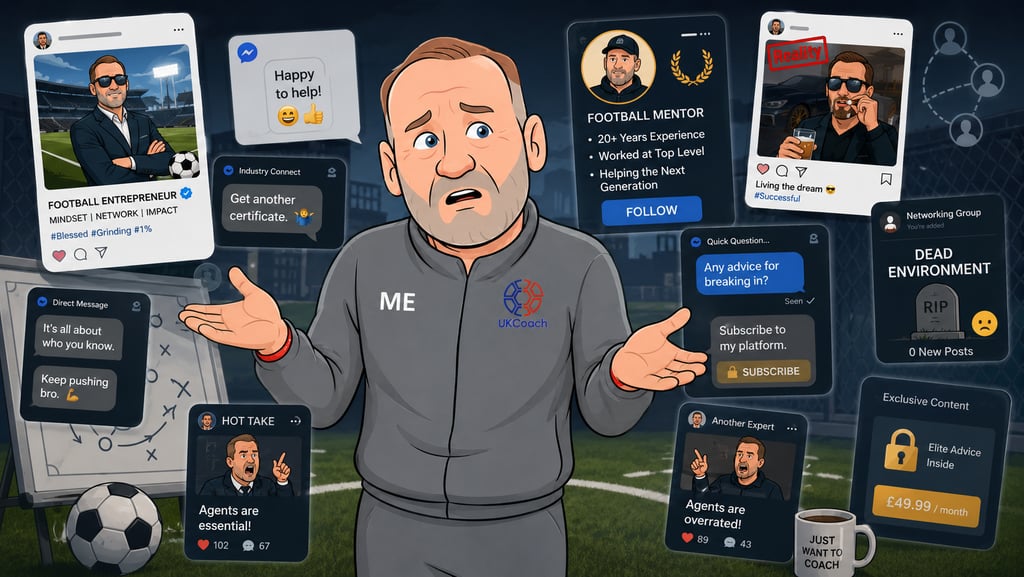
Football is a relatively small industry, but it has an enormous online presence.
Social media is filled with coaches, consultants, recruiters, agents, mentors, analysts and self-described industry experts discussing career development, professional networking and the growth of the game around the world.
Many present themselves as people who support others.
They publish motivational posts about helping coaches progress, claim involvement in successful careers and describe themselves as long-term advocates for football development in particular countries, regions or programmes.
Some appear to have extensive networks and impressive professional histories. Their profiles suggest that they are approachable, well positioned and willing to help people find opportunities within the industry.
However, the private experience of contacting some of these individuals can be very different from the image they present publicly.
This is not based solely on one disappointing interaction. It is something I have heard repeatedly from colleagues, fellow students and other coaches who have tried to network with people who claim to be influential within football.
They approach them respectfully, explain their experience and ask for reasonable advice about developing their careers.
In return, they often receive little or no meaningful guidance.
The response may be dismissive, extremely vague or limited to generic statements such as:
“You probably need another qualification.”
“You just need to keep applying.”
“You need to build your network.”
“Have you considered getting this certificate?”
There is nothing inherently wrong with any of that advice. Qualifications, applications and networking are all important.
The problem is that these responses often come from people whose public profiles suggest that they offer considerably greater insight, access and support.
Support With Conditions Attached
In some cases, the conversation quickly becomes a sales opportunity.
The person may offer very little useful advice unless the coach is prepared to subscribe to a website, pay for a membership, join a job forum, purchase mentoring sessions or sign up for a recruitment service.
There is nothing wrong with charging for a genuine professional service.
People invest time in building networks, developing expertise and operating businesses. They are entitled to charge for structured consultancy, recruitment support, mentoring or access to specialist resources.
The issue is transparency.
There is a significant difference between openly advertising a paid career-support service and building a public reputation around helping people, only to reveal privately that meaningful assistance is available exclusively behind a payment wall.
Basic professional courtesy should not require a subscription.
A person should be able to explain honestly whether they can help, how they can help and whether that assistance forms part of a paid service.
That would allow the individual seeking advice to make an informed decision.
Instead, some people maintain the public appearance of being generous industry supporters while providing almost nothing privately unless there is an immediate financial benefit.
Public Support, Private Dismissal
One of the most frustrating aspects is the contradiction between public statements and private conversations.
Someone may regularly post about how they have always supported the development of football in a particular country or part of the world.
They may praise the growth of the game, celebrate emerging programmes and describe themselves as advocates for coaches looking to work in that region.
Yet privately, the same person may tell someone that they are wasting their time trying to build a career there because the football environment is “dead,” limited or not worth pursuing.
People are entitled to hold critical opinions.
In fact, an honest assessment of a difficult football market can be extremely valuable. There may be genuine issues involving standards, recruitment, working conditions, visas, leadership, finances or long-term career prospects.
However, those private views should be consistent with the public image being promoted.
A person cannot continually present themselves as a committed supporter of football development in a region while privately dismissing that same environment whenever someone asks for practical guidance.
If the situation is poor, explain why.
If the opportunities are limited, provide context.
If the person’s expectations are unrealistic, be honest about it.
That would be useful advice.
Simply dismissing the ambition while continuing to benefit publicly from presenting yourself as a supporter of that region appears contradictory and insincere.
Career Claims That Do Not Stand Up to Scrutiny
Similar questions arise when people make ambitious claims about helping others find employment.
Some advertise that they have helped large numbers of coaches secure roles or suggest that they can help someone find a job within a surprisingly short period.
However, when approached, the actual support may consist of sending links to vacancies the person has already seen, directing them towards public job boards or recommending qualifications they already know about.
In some cases, the individual may claim credit for helping someone secure a job even though that person had already identified and applied for the position independently.
This creates an exaggerated impression of influence.
Sharing vacancies can be useful. Providing application feedback can be useful. Offering CV support, interview preparation or introductions can also be valuable.
However, these activities should be described accurately.
Forwarding a publicly advertised vacancy is not the same as securing someone a role.
Advising someone to apply for jobs is not the same as supporting them through the recruitment process.
Suggesting an additional qualification is not specialist career mentoring unless the recommendation is based on a detailed understanding of the person’s experience, goals and target market.
People should be honest about what their service actually provides.
Nobody Is Entitled to Free Consultancy
It is important to recognise that nobody is automatically entitled to another person’s time, contacts or expertise.
A well-connected football professional may receive a large number of messages. They cannot mentor everyone, review every CV or provide individual career plans to every person who contacts them.
They may also need to protect professional relationships and cannot always provide introductions.
That is understandable.
The issue is not that every message should result in a job opportunity or a lengthy consultation.
The issue is the lack of honesty and consistency.
A simple response can be enough:
“I do not have the capacity to help at the moment.”
“I do not have contacts in that area.”
“This is a paid service, and this is what it includes.”
“I cannot provide an introduction, but these are two organisations you could contact.”
“I do not think that market is currently strong, and these are the reasons why.”
Those responses are clear, respectful and useful.
Pretending to offer support, while providing almost nothing of value, wastes people’s time and damages trust.
Other Industries Often Handle This Better
In my experience, professional networking in other industries is generally more straightforward.
Someone either offers help, explains the limits of what they can provide or states clearly that they are unable to assist.
There is usually less performance around the interaction.
A professional may say that they do not know of any vacancies, cannot make an introduction or do not have sufficient knowledge of a particular market.
That honesty is rarely viewed negatively.
In fact, it often strengthens their credibility.
People do not expect everyone to have every answer. They do, however, expect people to be reasonably truthful about their influence and expertise.
Football sometimes seems to encourage a different culture.
The appearance of influence can become more important than providing actual value.
Follower numbers, photographs with recognisable people, event attendance and motivational content can create an impression of authority that is not always supported by practical knowledge or genuine professional relationships.
The Difference Between Networking and Selling Access
Networking should be based on relationships, shared knowledge and mutual professional respect.
It does not mean giving everything away for free.
It does mean treating people as more than potential customers.
When every conversation leads immediately towards a subscription, membership or paid service, networking stops being networking and becomes lead generation.
Again, there is nothing inherently wrong with selling.
The problem occurs when selling is disguised as mentorship, community support or professional generosity.
People seeking work in football are often vulnerable to this type of marketing.
They may have invested heavily in qualifications, relocated for opportunities, worked unpaid roles and spent years attempting to build credible experience.
Many are looking for honest direction rather than promises.
They should not be encouraged to believe that one more subscription, one more certificate or one more online forum will automatically unlock the industry.
Sometimes an additional qualification is necessary.
Sometimes the person’s CV needs improvement.
Sometimes their experience does not match the jobs they are targeting.
But sometimes the real answer is that football recruitment is inconsistent, highly relationship-driven and often resistant to people outside established networks.
Honest career advice should acknowledge that reality.
Football Is Smaller Than People Think
One reason this behaviour is particularly short-sighted is that football is a small industry.
People move between clubs, countries, organisations and levels of the game.
A student becomes a coach.
A grassroots coach becomes an academy manager.
An analyst becomes a head of recruitment.
A volunteer becomes a programme director.
The person asking for guidance today may later be in a position to recommend someone, share information, provide an introduction or influence a recruitment decision.
That does not mean people should help others purely because they may be useful in the future.
It means that dismissing people unnecessarily is poor professional judgement.
Careers develop in unpredictable ways.
Reputations also travel.
People speak to colleagues, classmates and other coaches about their experiences. When the same names and behaviours appear repeatedly, the gap between someone’s public profile and private conduct becomes increasingly visible.
Eventually, a carefully managed online image may no longer be enough to protect the reputation behind it.
Reputation Is Built Privately
A professional reputation is not created only through social media posts.
It is also built through private messages, conversations, introductions and small interactions that are never publicly visible.
It is easy to publish content about supporting coaches.
It is harder to consistently treat people with respect when there is no obvious personal benefit.
It is easy to claim involvement in someone’s success.
It is harder to explain clearly what role you actually played.
It is easy to speak about developing football around the world.
It is harder to provide an honest and balanced assessment when someone asks for advice about working in those environments.
People do not need to solve every problem or create opportunities for everyone who contacts them.
They simply need to be authentic.
If the service is paid, say so.
If the advice is limited, acknowledge that.
If the market is difficult, explain why.
If you cannot help, be honest.
That approach protects everyone’s time and maintains professional credibility.
Consistency Matters More Than Image
Football needs genuine mentors, recruiters, connectors and career-support professionals.
There are many people within the industry who provide excellent advice, make introductions, share opportunities and support others without exaggerating their involvement.
There are also valuable paid services that are clear about what they offer and deliver meaningful support to their clients.
The criticism is not directed at people earning money from their expertise.
It is directed at the mismatch between public claims and private behaviour.
A person cannot build a brand around supporting careers while treating most people who contact them as either an inconvenience or a potential subscription.
They cannot publicly celebrate the growth of football in a region while privately dismissing anyone attempting to work there.
They cannot repeatedly claim responsibility for helping people find jobs when their involvement was limited to sharing a link or offering generic advice.
Eventually, people notice the inconsistencies.
Football may provide space for carefully constructed online identities, but it is still an industry built on relationships.
Those relationships depend on trust.
The strongest professional reputation does not come from appearing influential. It comes from being reliable, honest and consistent.
What people say publicly matters.
How they behave privately usually reveals far more.